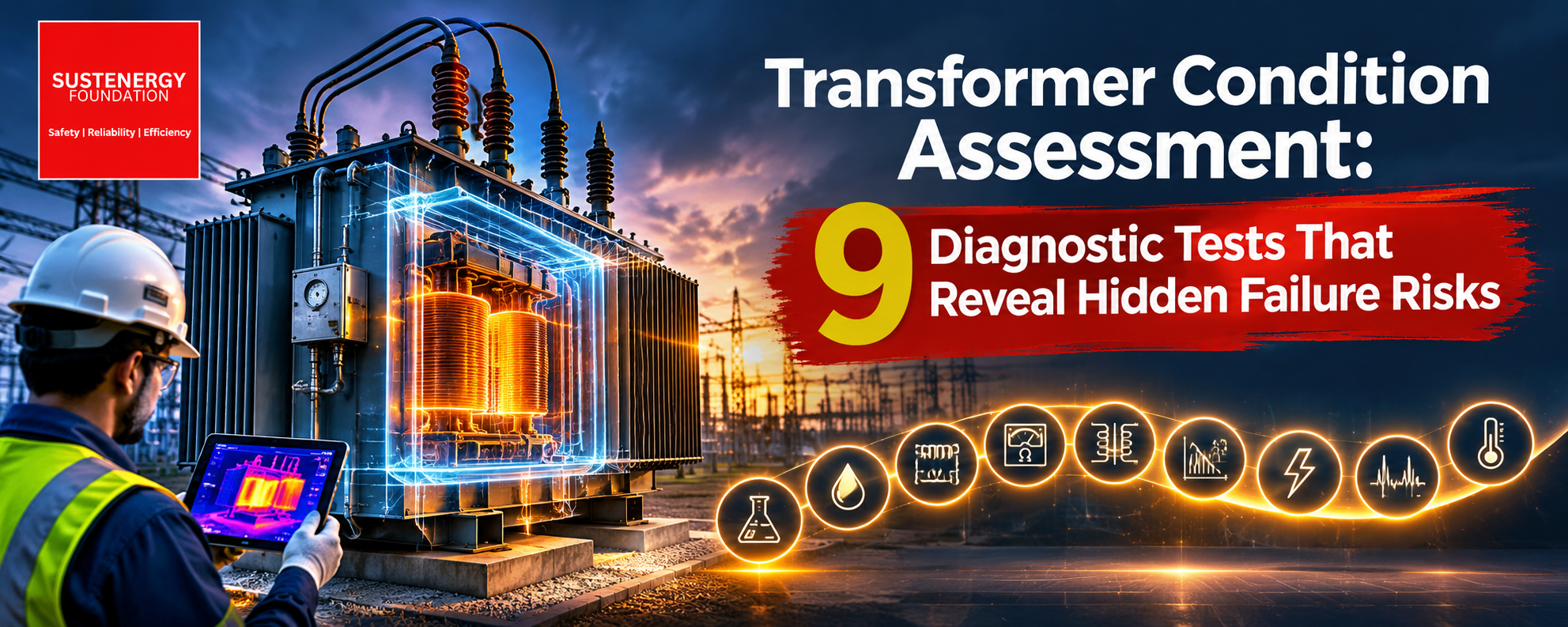
Transformer Condition Assessment: 9 Diagnostic Tests That Reveal Hidden Failure Risks
Why regular testing of oil-filled and dry-type transformers matters for safety, reliability and uninterrupted power.
Think about what depends on a transformer: hospitals, hotels, factories, IT parks, shopping complexes. When it works, nobody notices. When it fails, everybody does.
Here’s the thing: transformers rarely fail out of the blue. Insulation wears down, heat builds up, moisture creeps in, and connections loosen, all quietly, over months or years. A visual check and routine servicing won’t always catch it.
That’s where a proper transformer condition assessment comes in. Using the right transformer diagnostic testing, you can spot problems early, while they’re still cheap to fix. Here are nine tests that belong in any good assessment programme.
1. Insulation Resistance (IR) Test
This test checks the insulation between the windings, and between the windings and earth.
- Oil-filled transformers: it points to moisture contamination and ageing winding insulation.
- Dry-type transformers: it picks up damage from dust, moisture, contamination and heat over time.
Results depend on the test voltage and temperature, so correct for temperature and compare with past readings. A low or steadily falling value is an early warning.
2. Polarisation Index (PI) Test
PI is simply the insulation resistance at 10 minutes divided by the value at 1 minute. It gives a deeper look at insulation health, especially moisture-related problems.
- Oil-filled transformers: useful for judging winding insulation, though you need to keep the oil and paper characteristics in mind.
- Dry-type transformers: particularly good at flagging contamination and moisture.
One caution: don’t read PI on its own. Modern insulation systems can behave differently, so use it alongside other results.
3. Dissolved Gas Analysis (DGA)
For oil-filled units, dissolved gas analysis is one of the most valuable tools you have. When a transformer develops an electrical or thermal fault, the oil and paper insulation break down and release gases. Each gas tells part of the story:
- Hydrogen: partial discharge and some electrical faults.
- Methane and ethane: low-temperature overheating.
- Ethylene: higher-temperature overheating.
- Acetylene: high-energy arcing.
- Carbon monoxide and carbon dioxide: paper insulation ageing.
Results are interpreted using recognised methods such as IEC 60599 and IEEE C57.104, which also help decide how urgently action is needed. Note that DGA applies to oil-filled transformers. It isn’t a routine test for conventional dry-type units.
4. Transformer Oil BDV Test
The Breakdown Voltage test shows how well the oil can resist electrical stress. Moisture, particles and other contaminants weaken it and raise the risk of a breakdown.
An increasing AC voltage is applied across standard electrodes in an oil sample until it breaks down. A low value suggests the oil may need filtering, dehydration or a closer look. But BDV alone doesn’t tell you the oil is healthy, so moisture and other oil quality parameters need checking too.
5. Winding Resistance Measurement
This test measures the DC resistance of the windings, and it’s great at uncovering hidden physical problems such as:
- Loose or worn internal connections
- Poor contact in tap changers
- Broken strands or faulty joints
- Differences between phases
For both oil-filled and dry-type transformers, measure at a stable temperature, correct for it, and compare across phases and against earlier readings. Unusual differences can signal an electrical or mechanical defect in the making.
6. Transformer Turns Ratio (TTR) Test
The TTR test confirms the ratio between primary and secondary windings is what it should be. It can reveal:
- Shorted turns
- Wrong tap changer positions
- Winding connection problems
- Other winding abnormalities
Compare results with the nameplate data and the manufacturer’s tolerances. It works for both oil-filled and dry-type transformers.
7. Tan Delta / Dissipation Factor Test
Tan Delta measures the dielectric losses in the insulation. A rising value can point to moisture, contamination or insulation ageing.
- Oil-filled transformers: shows the dielectric condition of the winding insulation and, where relevant, the bushings.
- Dry-type transformers: helps spot deterioration in solid insulation.
Evaluate results at suitable test temperatures and voltages, following manufacturer recommendations and applicable standards.
8. Partial Discharge (PD) Measurement
Partial discharge testing looks for small electrical discharges that don’t fully bridge the insulation between conductors. They’re caused by voids, cracks, contamination, insulation defects or electrical stress, and left alone they slowly eat away at the insulation.
PD testing is especially valuable for dry-type transformers, where surface discharge can progressively damage the winding. In oil-filled units, PD activity can also point to internal insulation defects. Both online and offline techniques can detect discharge activity and help locate the problem area.
9. Thermography and Thermal Assessment
Infrared thermography lets you see heat problems without touching or shutting anything down. It helps find:
- Loose cable and busbar connections
- Overheating terminals
- Uneven phase loading
- Cooling system problems
- Abnormal temperature patterns
On oil-filled transformers, check the bushings, cable terminations, radiators and cooling equipment. On dry-type transformers, pay close attention to winding surfaces, ventilation passages, cooling fans and terminations. For the most useful picture, scan under representative operating load.
Quick Recap: Don’t Wait for a Failure
A transformer failure can mean serious equipment damage, lost production, fire hazards and disrupted critical services, especially in hospitals and other essential facilities.
A structured programme that combines electrical, chemical, insulation and thermal tests tells you far more than routine maintenance alone. Pairing it with sound preventive maintenance of transformers gives you the best protection. Which tests you choose, and how often, should depend on the transformer’s type, age, loading, environment, criticality and past results.
And remember: a transformer that’s running normally isn’t necessarily a healthy one. Testing reveals the hidden risks before they turn into expensive emergencies.
At Sustenergy Foundation, we carry out specialised electrical safety audits, transformer condition assessments and power quality assessments for hospitals, industries, hotels and commercial establishments.
Assess today. Prevent failures tomorrow.
Note: All blogs are prepared by Sustenergy Foundation based on our research in the respective sector/industry and on factual audits conducted by us, drawing from our expertise in the field through electrical safety audits, energy audits, or other related studies. These blogs are published with the purpose of creating awareness and sharing technical expertise with employees at various levels — from laypersons to experts — and are prepared in accordance with the blog policy of Sustenergy Foundation.
Prepared by Arjun Pradeep, Deputy Manager
Reviewed and approved by Jayakumar Nair, Managing Director