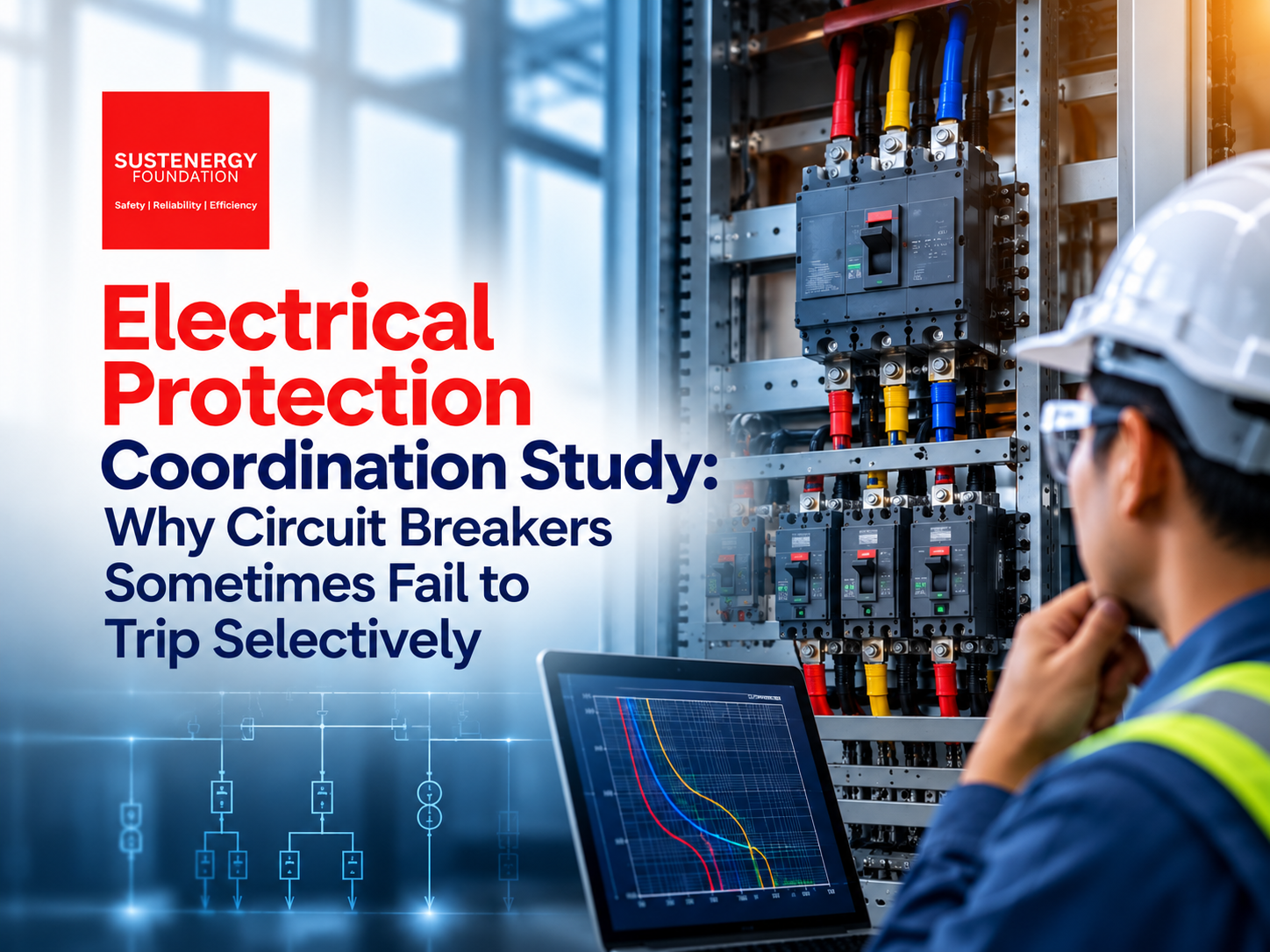
Electrical Protection Coordination Study: Why Circuit Breakers Sometimes Fail to Trip Selectively
Introduction: Why Does a Small Electrical Fault Sometimes Cause a Major Power Outage?
Imagine a short circuit occurring in a distribution board inside a hospital, hotel, commercial building, or industrial facility. Ideally, the circuit breaker protecting the faulty circuit should trip immediately, isolate the fault, and allow the rest of the electrical system to continue operating normally.
But what happens when the main incomer circuit breaker trips instead?
A fault affecting just one socket, piece of equipment, or outgoing circuit could result in a complete power interruption across an entire floor, department, or production area.
In hospitals, such interruptions can affect critical equipment and essential services. In hotels and commercial buildings, they can disrupt daily operations, inconvenience occupants, and create avoidable safety concerns. In industrial facilities, an unexpected shutdown can lead to production losses and equipment downtime.
Why does this happen?
One possible reason is a lack of proper electrical protection coordination.
An electrical protection coordination study helps engineers assess whether circuit breakers, protective relays, and other protective devices operate in the correct sequence when an electrical fault occurs.
For organisations that depend on a safe and reliable power supply, protection coordination is an important part of electrical system design, maintenance, and risk management.
What Is an Electrical Protection Coordination Study?
Electrical protection coordination is the process of selecting and configuring protective devices so that the device nearest to a fault operates first, wherever selective operation can be achieved safely.
The objective is straightforward: isolate the faulty section of the electrical network without unnecessarily interrupting the power supply to healthy sections.
A protection coordination study evaluates the performance of circuit breakers, fuses, protective relays, and associated equipment under different fault conditions.
Engineers analyse fault-current levels, protection settings, equipment characteristics, and time-current curves to determine whether the selected devices can operate in the intended sequence.
The study may also assess whether the electrical system can operate safely under different conditions, such as utility supply, generator operation, UPS-supported distribution, and other relevant configurations.
When properly conducted, an electrical protection coordination study can help organisations improve power system reliability, reduce unnecessary outages, and strengthen their overall electrical safety management.
5 Reasons Why Circuit Breakers Fail to Trip Selectively
1. Incorrect Circuit Breaker Protection Settings
Incorrect protection settings are one of the issues that engineers investigate when a circuit breaker trips unnecessarily or fails to coordinate with downstream devices.
Modern circuit breakers may have long-time, short-time, instantaneous, and ground-fault protection functions, depending on their design.
If these settings are not selected appropriately, an upstream breaker may trip before the downstream breaker has sufficient opportunity to clear the fault.
For example, a short circuit in an outgoing distribution circuit may cause both the outgoing breaker and the main incomer breaker to trip if their operating characteristics overlap.
This can result in a larger power interruption than necessary.
How can this be prevented?
A detailed electrical protection coordination study should be carried out using the actual system configuration, calculated fault currents, and manufacturers' time-current characteristics.
Protection settings should be reviewed by qualified electrical engineers and verified against the equipment manufacturer's recommendations and applicable requirements.
2. High Short-Circuit Current Levels
Short-circuit current is an important factor in determining how circuit breakers respond to electrical faults.
When a high fault current occurs, the instantaneous protection function of a circuit breaker may operate without an intentional time delay.
If both upstream and downstream breakers respond to the same fault current, selective tripping may not be achieved.
This is particularly important in electrical installations with high-capacity transformers, parallel transformers, or other sources that can contribute significant fault current.
However, simply increasing the upstream breaker setting or introducing a time delay is not always the right solution. Such changes can affect fault-clearing time, equipment protection, and arc-flash risk.
How can this be prevented?
A short-circuit analysis should be performed alongside the protection coordination study to determine the minimum and maximum prospective fault currents at relevant points in the electrical network.
Engineers should review breaker characteristics, instantaneous pickup settings, short-time delay options, and manufacturer-verified selectivity limits.
The final settings must maintain adequate protection for the equipment and electrical installation.
3. Incorrect Selection of Circuit Breakers
Selecting circuit breakers based only on their current ratings can lead to coordination problems.
Two circuit breakers with different rated currents do not automatically guarantee selective operation.
Their internal operating mechanisms, trip-unit characteristics, current-limiting behaviour, and manufacturing tolerances may differ.
For example, a 250 A downstream circuit breaker connected to a 400 A upstream breaker does not necessarily ensure that the downstream breaker will trip first under every fault condition.
The actual result depends on the specific devices, their settings, and the fault current available at the point of the fault.
How can this be prevented?
Circuit breakers should be selected based on the electrical load, prospective short-circuit current, equipment withstand capability, and required coordination performance.
Engineers should consult manufacturers' time-current curves and selectivity tables to establish the conditions under which selective operation can be achieved.
This is especially important when designing or upgrading electrical distribution systems in hospitals, hotels, commercial buildings, and industrial facilities.
4. Changes in the Electrical Installation
Electrical systems rarely remain unchanged throughout the life of a building or industrial facility.
Additional loads, transformer replacements, generator installations, solar PV systems, UPS upgrades, and modifications to electrical distribution boards can change the available fault current and the way protective devices operate.
For example, a circuit breaker coordination study performed when a facility had a single transformer may no longer be sufficient after the installation of an additional transformer operating in parallel.
Similarly, changing the operating configuration of a generator or UPS-supported distribution system may affect fault-current levels and protective-device performance.
If the original protection settings are retained without reassessment, the electrical installation may no longer operate as intended.
How can this be prevented?
The protection coordination study should be reviewed whenever significant changes are made to the electrical network.
An updated single-line diagram, revised equipment data, and verified protection settings help ensure that the study reflects the installation as it operates today.
Regular electrical safety audits can also help identify changes in the installation that require further engineering assessment.
5. Incorrect Relay Settings or Protection System Failures
In medium-voltage systems and advanced low-voltage installations, selective protection may depend on protective relays, interlocking arrangements, communication-assisted protection, and associated control circuits.
Incorrect relay settings, defective wiring, failed trip circuits, or communication problems can interfere with the intended protection sequence.
For example, a protective relay may detect a fault correctly but fail to initiate the expected circuit breaker operation because of a problem in the trip circuit.
In other situations, incorrect coordination between upstream and downstream relays may cause an upstream device to disconnect more of the electrical network than necessary.
How can this be prevented?
Protection system verification should include appropriate checks of relay settings, trip-circuit integrity, interlocking logic, and communication-assisted functions where installed.
Secondary injection testing and functional testing should be performed by competent personnel using suitable procedures and equipment.
Testing should verify not only that the protection device detects the intended condition but also that the complete protection and tripping arrangement operates correctly.
How Does an Electrical Protection Coordination Study Improve Safety and Reliability?
A protection coordination study is not simply about adjusting circuit breakers. It involves understanding how the electrical installation behaves under normal operating conditions and during faults.
A comprehensive study generally includes the following activities.
1. Reviewing the Electrical Single-Line Diagram
Engineers collect and review the electrical single-line diagram, transformer ratings, cable specifications, circuit breaker details, protective relay settings, and other relevant system information.
Accurate documentation is essential because incorrect or outdated information can affect the reliability of the study.
2. Performing Short-Circuit Analysis
Short-circuit analysis determines the prospective fault currents at relevant locations in the electrical network.
Both minimum and maximum fault-current conditions may need to be assessed, depending on the protection function and the operating configuration.
The results help engineers evaluate whether protective devices can detect and interrupt the expected faults within their applicable ratings.
3. Analysing Time-Current Characteristic Curves
Time-current characteristic curves show how quickly a protective device is expected to operate at different current levels.
By comparing upstream and downstream curves, engineers can identify areas where the devices may operate together or where adequate selectivity may not be achieved.
This analysis helps determine whether protection settings or equipment selection need to be revised.
4. Verifying Circuit Breaker Ratings
Circuit breakers must be suitable for the prospective fault current at their installation points.
The study should consider the relevant breaking capacity, short-time withstand capability where applicable, and coordination with upstream and downstream equipment.
A breaker with an unsuitable interrupting rating can create a serious electrical safety concern, even if its current rating appears appropriate for the connected load.
5. Evaluating Different Operating Conditions
Electrical installations may operate through utility supplies, standby generators, UPS systems, and other power sources.
The available fault current and protection behaviour may differ between these operating modes.
Where relevant, the coordination study should evaluate these configurations rather than relying on a single assumed operating condition.
6. Recommending Corrective Actions
Based on the study results, engineers may recommend revised protection settings, alternative circuit breakers, suitable protective relays, or other design improvements.
Any proposed changes must be checked for their impact on fault-clearing time, equipment protection, arc-flash hazards, and system reliability.
The objective is to achieve the best practical level of selectivity without compromising safety.
7. Documenting and Verifying the Final Settings
The final report should document the study assumptions, fault-current calculations, coordination curves, recommended settings, and any identified limitations.
After approved changes are implemented, appropriate verification and testing should confirm that the protection system performs as intended.
The report should also establish when the study needs to be reviewed again, particularly after significant modifications to the electrical installation.
Why Is Protection Coordination Important for Hospitals, Hotels, and Industrial Facilities?
Electrical protection coordination is particularly important in buildings where an unexpected power interruption can affect essential services, operational continuity, or occupant safety.
Hospitals and Healthcare Facilities
Hospitals depend on electrical power for medical equipment, critical care areas, diagnostic systems, ventilation, lighting, and essential support services.
An unnecessary trip of an upstream circuit breaker can interrupt several distribution circuits even when the original fault is limited to one section.
A properly engineered protection strategy can help minimise the extent of such interruptions and support the reliable operation of essential electrical services.
Protection coordination should form part of a wider electrical safety management programme that includes appropriate testing, preventive maintenance, emergency power assessment, and periodic electrical safety audits.
Hotels and Commercial Buildings
Hotels, shopping centres, offices, and other commercial facilities depend on reliable electrical distribution for lighting, lifts, HVAC systems, IT infrastructure, and daily operations.
Poor coordination can cause unnecessary shutdowns, inconvenience occupants, disrupt business activities, and increase maintenance costs.
A protection coordination study helps facility managers and electrical engineers identify potential coordination issues and plan suitable corrective measures.
Industrial and Manufacturing Facilities
Industrial plants often contain large motors, transformers, production machinery, and complex electrical distribution networks.
An electrical fault can lead to equipment damage, production downtime, and interruptions to connected processes.
In such facilities, proper coordination between protective devices helps isolate faults more effectively and reduce the likelihood of unnecessary shutdowns across unaffected areas.
However, selective operation must always be evaluated against equipment ratings, process safety requirements, and the characteristics of the electrical installation.
What Is the Role of an Electrical Safety Audit?
An electrical safety audit helps organisations assess the condition of their electrical installation, identify potential hazards, and evaluate whether important safety measures are being maintained.
Depending on the agreed scope, an audit may examine electrical distribution boards, circuit breakers, earthing arrangements, protective devices, cable installations, electrical maintenance practices, and available technical documentation.
A protection coordination study and an electrical safety audit serve related but different purposes.
An electrical safety audit evaluates electrical safety conditions and identifies concerns, while a protection coordination study uses engineering calculations and device characteristics to assess the intended operation of protective devices.
An audit may identify symptoms such as repeated circuit breaker tripping, unexplained power interruptions, outdated protection documentation, or modifications that have not been reflected in the electrical drawings.
These findings may indicate that a detailed protection coordination study or further testing is required.
For facilities seeking to improve electrical safety, combining appropriate inspection, testing, maintenance, and engineering analysis can provide a more complete understanding of electrical risks.
Sustenergy Foundation supports electrical safety awareness and assessment initiatives to help organisations recognise electrical hazards and improve the safety and reliability of their installations.
Learn more about the electrical safety services offered by Sustenergy Foundation.
When Should You Consider an Electrical Protection Coordination Study?
An organisation should consider a protection coordination study when:
- A new electrical installation is being designed or commissioned.
- A transformer, generator, UPS system, or major electrical distribution component is added or replaced.
- Circuit breakers trip unexpectedly or multiple breakers operate during a single fault.
- The electrical system undergoes a significant load or configuration change.
- Protective relays or circuit breakers are replaced with different models.
- Existing protection settings or coordination documentation are unavailable or outdated.
- An electrical incident raises concerns about the operation of the protection system.
- An engineering assessment identifies possible short-circuit protection or coordination deficiencies.
The need for a study should be determined by qualified electrical professionals based on the installation's design, operating conditions, applicable requirements, and risk profile.
Conclusion: Is Your Electrical Protection System Properly Coordinated?
When a circuit breaker trips, the important question is not only whether it disconnects the faulty circuit. It is also whether the correct protective device operates and whether the remaining electrical installation can continue operating safely.
Circuit breakers do not achieve selective coordination simply because their current ratings are different. Their performance depends on fault-current levels, trip characteristics, protection settings, equipment ratings, and the overall configuration of the electrical network.
An electrical protection coordination study helps engineers identify potential coordination problems, evaluate protective-device performance, and recommend improvements that support electrical safety and system reliability.
For hospitals, hotels, commercial buildings, and industrial facilities, protection coordination should be considered alongside electrical safety audits, preventive electrical maintenance, short-circuit analysis, and appropriate inspection and testing.
At Sustenergy Foundation, we recognise the importance of electrical safety awareness and systematic risk assessment in helping organisations maintain safer and more reliable electrical installations.
Before your next unexpected power outage, ask yourself: Are your circuit breakers properly coordinated, and does your protection system reflect the actual condition and configuration of your electrical installation?
Addressing this question proactively can help reduce avoidable interruptions, strengthen electrical safety management, and support long-term operational reliability.