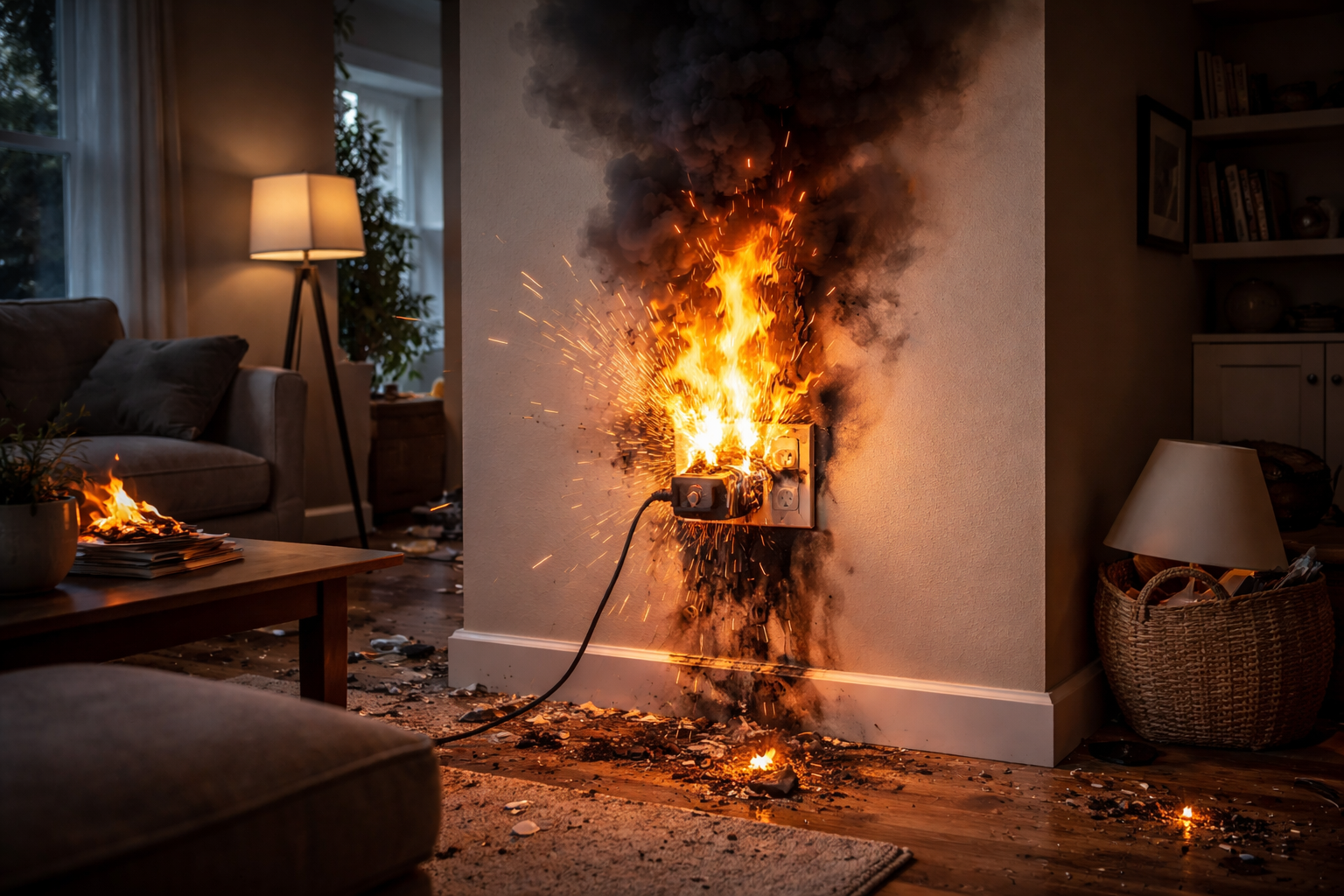
Kerala Home Fire Hazard – A Family’s Precious World Lost (Estimated Loss: ₹60 Lakhs+)
Happened to read a shocking piece of news in the newspaper about a residential fire hazard that occurred barely 6 km away from our Kottayam office. When we visited the property, the sight was heartbreaking. The house owner had already cleared most of the debris, but the damage was unimaginable—every part of the interior was destroyed. Furniture, air conditioners, even ceiling fans were melted beyond recognition.
Thankfully, the tragedy did not claim any lives, as the family members were away at the time. But imagine the pain of returning home to find your safe haven reduced to ashes.
The closed doors delayed the neighbours from noticing the fire, and by the time help arrived, the fire services had to battle the flames with water to bring it under control.
What Could Have Happened?
From discussions with the house owner, the likely cause was an electrical issue—commonly referred to as a “short circuit.” There were no signs of sabotage or external fire sources. The fault could have originated from any electrical equipment: a lamp, a fan, a television, or even an air conditioner. The owner had no idea which appliance was ON at the time.
This is where the importance of a professional Electrical Safety Audit becomes evident. A systematic audit helps identify hidden electrical risks, deteriorated wiring, overloaded circuits, improper protections, and non-compliance with safety standards—long before they turn into disasters.
Why Didn’t Protective Devices Safeguard the Home?
On inspecting the main switchboard, we found RCCBs (for earth leakage protection) and MCBs (for overcurrent protection). Some MCBs were OFF or may have tripped during the fault. Shockingly, the RCCB was bypassed, leaving the home completely unprotected against earth leakages.
Even worse, the RCCB installed was of 100 mA rating, which is insufficient to protect against electrical shock. For perspective, if more than 30 mA of current passes through the human body, it can be fatal. That’s why every home must have a 30 mA RCCB.
Had a properly connected 30 mA RCCB been installed in the distribution board (DB), this family might have been spared the devastating fire and the loss of over ₹60 lakhs. More importantly, their home—their memories, their comfort, their safe space—would still be intact.
Prevention Is Always Cheaper Than Recovery
Regular inspections and an expert-led Electrical Safety Audit can reveal:
- Bypassed or defective RCCBs
- Incorrect MCB ratings
- Aging or overheated cables
- Poor earthing systems
- Unsafe wiring practices
Engaging a qualified agency—often recognised as a Top Electrical Safety Audit firm in India—ensures that your home or facility is evaluated as per national and international safety standards, and corrective actions are clearly defined.
Choosing the Best Electrical Safety Audit firm in India is not about compliance alone; it is about safeguarding lives, protecting property, and preserving peace of mind.
Quick Recap – A Family Lesson for All of Us
- Every home must have a 30 mA RCCB to protect against earth leakages and fire hazards.
- Never allow protective devices to be bypassed or tampered with.
- Conduct a professional Electrical Safety Audit at regular intervals.
Remember, your family’s life is priceless, and your home is more valuable than any asset. Electrical safety is not just a technical matter—it’s about protecting the people we love and the place we call home.
—--------------------------------------------------------------------------------------------------------------------
Note: All blogs are prepared by Sustenergy Foundation based on our research in the respective sector/industry and on factual audits conducted by us, drawing from our expertise in the field through electrical safety audits, energy audits, or other related studies. These blogs are published with the purpose of creating awareness and sharing technical expertise with employees at various levels — from laypersons to experts — and are prepared in accordance with the blog policy of Sustenergy Foundation.
Prepared by Sreelakshmi. S Head - Engineering
Reviewed and approved by Jayakumar Nair, Managing Director