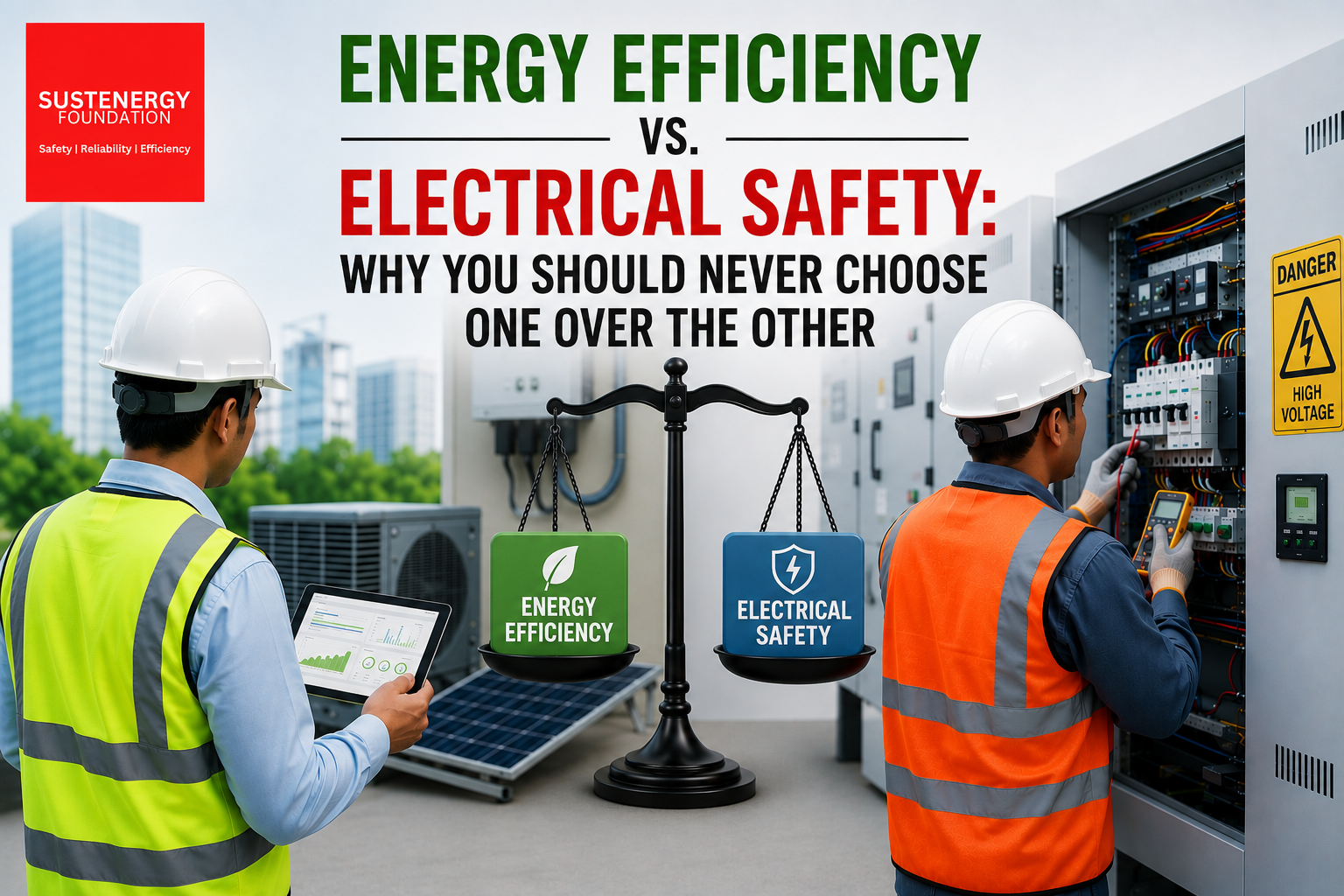
Energy Efficiency vs. Electrical Safety: Why You Should Never Choose One Over the Other
As electricity costs continue to rise and organizations work towards sustainability goals, energy efficiency has become a top priority across industries. Businesses are investing in energy audits, LED lighting upgrades, high-efficiency HVAC systems, Variable Frequency Drives (VFDs), power factor correction systems, solar power, and other energy-saving technologies to reduce operational costs and carbon emissions.
These initiatives are essential. They help organizations become more sustainable while improving profitability.
However, there is one important principle that should never be overlooked:
Energy efficiency should never come at the cost of electrical safety.
Reducing electricity consumption is important. Protecting people from electric shock, preventing electrical fires, ensuring business continuity, and safeguarding valuable assets are even more critical.
The most successful facilities understand that **energy efficiency and electrical safety are complementary—not competing—objectives.
Understanding the Difference Between an Energy Audit and an Electrical Safety Audit
Although both disciplines deal with electrical systems, they serve very different purposes.
What Does an Energy Audit Focus On?
An Energy Audit evaluates how efficiently a facility consumes energy. The goal is to identify opportunities to reduce energy usage, lower electricity bills, and improve operational efficiency.
Typical recommendations include:
- LED lighting upgrades
- HVAC optimization
- Variable Frequency Drive (VFD) installation
- Power factor improvement
- Compressed air optimization
- Solar PV integration
- Equipment scheduling improvements
The key question an energy auditor asks is:
"How can this facility consume less energy while maintaining performance?"
What Does an Electrical Safety Audit Focus On?
An Electrical Safety Audit goes much deeper into the safety and reliability of an electrical installation.
It evaluates whether the electrical system has been:
- Properly designed
- Correctly installed
- Safely operated
- Adequately maintained
- Properly protected against faults
The questions become:
- Is the electrical installation safe?
- Will protective devices operate during a fault?
- Is there a risk of electric shock?
- Could an electrical fault start a fire?
- Is the earthing system effective?
- Are overloaded circuits creating hidden risks?
An Electrical Safety Audit focuses on protecting:
- Human life
- Property
- Critical equipment
- Business continuity
While an energy audit saves electricity, an electrical safety audit saves lives.
Why This Difference Matters
Energy auditing is a multidisciplinary field.
Professionals from various engineering disciplines—including electrical, mechanical, production, chemical, instrumentation, and thermal engineering—contribute valuable expertise to improving energy efficiency.
For example:
- Mechanical engineers optimize HVAC systems.
- Chemical engineers improve industrial processes.
- Production engineers reduce manufacturing losses.
- Thermal specialists improve boiler and furnace efficiency.
All of these professionals play an important role in reducing energy consumption.
However, expertise in energy management does not automatically mean expertise in electrical safety.
Electrical safety is a specialized branch of engineering that requires a deep understanding of electrical systems, fault behavior, and protection mechanisms.
Electrical Safety Requires Specialized Engineering Knowledge
A competent Electrical Safety Auditor must understand far more than visual inspections or checklists.
They should have expertise in areas such as:
- Protection coordination
- Short-circuit analysis
- Earth fault loop impedance
- Earthing and bonding systems
- RCCB and RCBO selection
- Circuit breaker characteristics
- Transformer protection
- Cable sizing and derating
- Load balancing
- Neutral current analysis
- Insulation resistance testing
- Thermal imaging interpretation
- Electrical fault diagnosis
- Applicable Indian Standards (IS), IEC Standards, CEA Regulations, and National Building Code requirements
These are engineering decisions that require specialized training and practical experience.
Electrical Safety Is More Than a Checklist
One of the biggest misconceptions is that an electrical safety audit simply involves filling out a checklist.
In reality, identifying a defect is only the beginning.
A competent auditor must understand:
- Why the problem exists
- What risks it creates
- Whether the proposed solution introduces additional hazards
Consider This Example
Suppose an RCCB trips repeatedly.
A quick solution may seem obvious:
Replace the 30 mA RCCB with a higher-rated device to stop nuisance tripping.
But is that really solving the problem?
A skilled electrical safety engineer would investigate:
- Is there insulation leakage?
- Is the earthing system functioning correctly?
- Is there a neutral-earth fault?
- Is the circuit overloaded?
- Are multiple circuits sharing neutral conductors?
- Is moisture affecting the installation?
Simply replacing the RCCB without identifying the root cause may reduce tripping—but it can also remove critical protection against electric shock.
The symptom disappears, but the hazard remains.
Every Energy-Saving Project Should Pass a Safety Check
Every major energy conservation measure involving electrical systems should be evaluated from both energy efficiency and electrical safety perspectives.
For example:
Variable Frequency Drives (VFDs)
VFDs can significantly reduce energy consumption.
However, engineers should also evaluate:
- Harmonics
- Cable suitability
- Motor insulation
- Leakage currents
- Earthing requirements
- Electromagnetic compatibility (EMC)
- Protective device coordination
Solar PV Systems
Solar energy improves sustainability.
But engineers must also assess:
- DC isolation
- Overcurrent protection
- Lightning protection
- Earthing
- Inverter safety
- Arc fault risks
Transformer Upgrades
Higher-efficiency transformers reduce losses.
At the same time, engineers should verify:
- Fault current levels
- Protection settings
- Cable capacity
- Coordination with downstream devices
HVAC Optimization
Energy-efficient HVAC systems reduce electricity consumption.
However, changes should also consider:
- Electrical loading
- Cable heating
- Starting currents
- Motor protection
- Emergency power compatibility
The real question should never be:
"Is this project energy efficient?"
Instead, organizations should ask:
"Is this project energy efficient, electrically safe, reliable, and sustainable?"
Can One Professional Perform Both Audits?
Yes—provided the individual has the required competency.
An experienced electrical engineer with training in energy management can competently perform both an Energy Audit and an Electrical Safety Audit.
However, the reverse should not be assumed.
Organizations should carefully evaluate whether the auditor has:
- A strong electrical engineering background
- Practical experience with electrical installations
- Knowledge of electrical testing
- Familiarity with applicable standards
- Expertise in electrical protection systems
- Experience in fault analysis
This becomes especially important for critical facilities such as:
- Hospitals
- Hotels and Resorts
- Commercial Buildings
- Data Centres
- Industrial Plants
- Educational Institutions
- IT & ITES Facilities
- High-Rise Buildings
In these environments, electrical failures can have severe consequences, including fire, equipment damage, service disruption, and risk to human life.
Safety, Reliability, and Efficiency Must Work Together
The best-managed facilities do not see electrical safety, energy efficiency, and system reliability as separate goals.
They understand that all three are interconnected.
A building that wastes electricity is not sustainable.
But a highly energy-efficient building with poor electrical protection is equally unacceptable.
The ideal electrical system should be:
- Safe for people
- Reliable for operations
- Efficient in energy consumption
- Compliant with standards
- Sustainable throughout its lifecycle
That is the true foundation of responsible facility management.
Final Thoughts
Energy efficiency improves profitability, reduces environmental impact, and supports sustainability goals.
Electrical safety protects people, prevents fires, safeguards assets, and ensures uninterrupted operations.
One should never be sacrificed for the other.
At Sustenergy Foundation, we believe organizations deserve both.
Our integrated approach combines Energy Audits with Professional Electrical Safety Audits, helping industries, hospitals, hotels, commercial buildings, and institutional facilities achieve safer, more reliable, and more energy-efficient electrical systems.
Because the best electrical system isn't simply the one that uses the least electricity.
It's the one that delivers power safely, reliably, and efficiently—every single day.