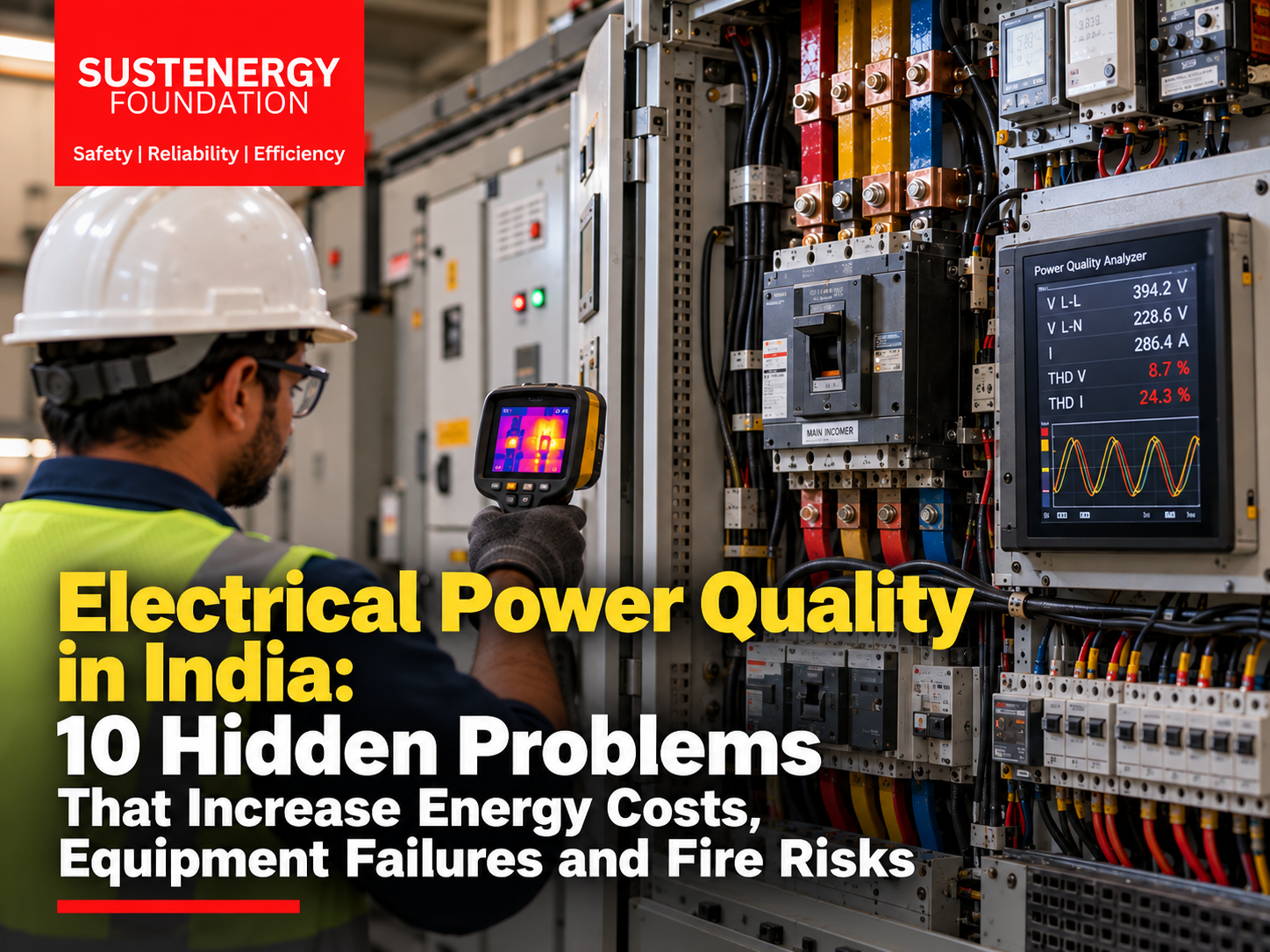
Electrical Power Quality in India: 10 Hidden Problems That Increase Energy Costs, Equipment Failures and Fire Risks
When electricity bills increase, most facility managers immediately look at energy consumption, equipment efficiency or rising electricity tariffs.
But what if the problem is not simply how much electricity you are consuming—but the quality of electricity reaching your equipment?
This is where electrical power quality becomes important.
Poor power quality can remain hidden for months or even years. A facility may continue operating normally while motors run hotter, transformers experience additional stress, capacitors fail repeatedly, UPS systems develop problems and sensitive electronic equipment experiences unexpected shutdowns.
For hospitals, hotels, manufacturing plants, IT/ITES facilities, commercial buildings and other critical facilities, these problems can eventually translate into higher energy costs, equipment failures, production downtime and increased electrical fire risks.
A professional Power Quality Audit can help identify these hidden problems before they become expensive failures.
What Is Electrical Power Quality?
Electrical power quality refers to how closely the electricity supplied to a facility matches the expected voltage, frequency and waveform characteristics required for electrical equipment to operate safely and efficiently.
Modern buildings and industries are using more equipment based on power electronics, including:
- Variable Frequency Drives (VFDs)
- UPS systems
- LED lighting
- Computers and data-centre equipment
- Solar inverters
- EV chargers
- Battery energy storage systems
- Electronic control systems
- Rectifiers and switched-mode power supplies
These technologies improve efficiency and automation, but many of them are also nonlinear loads that can introduce disturbances into an electrical network.
That means a facility can have a perfectly normal-looking electricity meter while still experiencing significant power quality problems.
Here are 10 issues that deserve closer attention.
1. Harmonic Distortion
Harmonics are one of the most common power quality issues in modern electrical installations.
Equipment such as VFDs, UPS systems, LED drivers, computers, rectifiers and solar inverters can generate harmonic currents.
These unwanted currents can increase heating and losses in:
- Transformers
- Cables
- Busbars
- Motors
- Neutral conductors
- Capacitors
In severe cases, harmonic distortion can contribute to nuisance tripping, overheating and premature equipment failure.
For facilities with a high concentration of nonlinear loads, harmonic analysis should therefore be an important part of a professional Power Quality Audit.
IEEE 519 provides harmonic-control objectives at the Point of Common Coupling (PCC) for systems containing nonlinear loads.
2. Excessive Neutral Current
The neutral conductor is sometimes overlooked during electrical inspections.
However, triplen harmonics—particularly third-order harmonics—can accumulate in the neutral instead of cancelling out as expected.
This can result in surprisingly high neutral current even when the three-phase loads appear reasonably balanced.
If the neutral conductor, termination or associated equipment is not adequately designed and maintained, excessive heating can develop.
Over time, this can increase:
- Cable temperature
- Insulation deterioration
- Electrical losses
- Equipment stress
- Fire risk
A Power Quality Analysis that measures phase and neutral currents can help identify this condition.
3. Voltage Sags
Have you ever noticed equipment suddenly restarting or a control system unexpectedly shutting down?
A voltage sag could be one of the reasons.
Large motors, chillers, compressors, pumps and other high-inrush loads can produce short-duration voltage dips when they start.
Sensitive equipment may respond by:
- Resetting
- Tripping
- Losing control settings
- Dropping contactors
- Interrupting automated processes
In hospitals and IT facilities, even a short interruption can have serious operational consequences.
A Power Quality Audit in hospitals, hotels, industries and commercial buildings can help identify recurring voltage sag events and determine their possible causes.
4. Voltage Swells and Overvoltage
Voltage problems are not limited to low voltage.
A sudden reduction in load, capacitor switching operation or certain network faults can result in temporary voltage increases.
Repeated exposure to overvoltage can place additional stress on electronic power supplies, insulation and other electrical components.
For sensitive equipment, these events may shorten equipment life even when the normal voltage measured during a routine inspection appears acceptable.
This is why continuous power quality monitoring can provide much more information than a single voltage measurement.
5. Transient Overvoltages
Some electrical disturbances happen so quickly that a conventional multimeter may never capture them.
Lightning, switching operations and capacitor switching can produce short-duration voltage transients.
These events can affect:
- PLCs
- Control systems
- Medical equipment
- IT equipment
- Communication systems
- Electronic power supplies
- Insulation systems
A facility may therefore experience repeated electronic equipment failures without realizing that transient overvoltages are contributing to the problem.
Appropriate surge protection, grounding and electrical safety inspection are important parts of managing this risk.
6. Voltage and Current Unbalance
Three-phase electrical systems perform best when the phases are reasonably balanced.
Unequal loading or an unbalanced incoming supply can result in additional heating and stress in motors and transformers.
For motors, even relatively small voltage unbalance can have a significant effect on operating conditions.
Possible consequences include:
- Increased motor heating
- Higher losses
- Reduced motor efficiency
- Increased vibration
- Premature motor failure
- Reduced equipment reliability
During an Industrial Electrical Audit or Energy Audit, phase loading and voltage/current balance should therefore be checked.
7. Poor Power Factor
Power factor is another area that directly affects electrical system performance.
When power factor is low, the electrical system has to carry more current to deliver the same amount of useful power.
Higher current can increase:
- I²R losses
- Cable heating
- Transformer loading
- Distribution losses
- Infrastructure requirements
Depending on the applicable electricity tariff, poor power factor may also contribute to additional charges or penalties.
Power factor assessment should therefore form part of an Energy Audit and Power Quality Audit, particularly in industrial and commercial facilities with large inductive loads.
8. Capacitor–Harmonic Resonance
Power-factor-correction capacitors are useful for improving power factor—but they can create problems when harmonics are already present in the electrical network.
Under certain conditions, the inductance of the electrical system and capacitor banks can create resonance at particular frequencies.
This may amplify harmonic currents and result in:
- Capacitor overheating
- Capacitor failure
- Fuse operation
- Nuisance tripping
- Increased harmonic distortion
- Damage to electrical equipment
Simply installing additional capacitors is therefore not always the right solution.
Before modifying a capacitor bank, it is important to understand the existing power quality, harmonic profile and electrical system characteristics.
9. Loose and High-Resistance Connections
Not every electrical problem is caused by sophisticated equipment.
Sometimes, the problem is simply a poor connection.
A loose termination or high-resistance connection can create a localized hot spot. Under continuous loading, that temperature can gradually increase.
The problem can become more serious when the circuit is carrying harmonic currents or operating close to its capacity.
This is one reason electrical thermography is such a valuable preventive-maintenance technique.
Thermal imaging can identify abnormal temperature patterns in:
- Distribution boards
- MCC panels
- LT panels
- HT panels
- Busbars
- Cable terminations
- Transformers
- Switchgear
Sustenergy Foundation also uses thermal imaging inspection as a diagnostic approach for identifying heat-related electrical problems that may not be visible during a conventional inspection.
10. The Biggest Problem: Not Measuring Power Quality
Perhaps the most overlooked power quality problem is the absence of power quality monitoring.
A conventional energy meter can tell you how many units of electricity your facility has consumed.
But it may not tell you:
- How much harmonic distortion exists
- Whether voltage is regularly sagging
- Whether voltage swells are occurring
- Whether phase voltage is unbalanced
- Whether neutral current is excessive
- Whether transient events are occurring
- Whether power factor is changing significantly
- Whether certain equipment is creating disturbances
This is why Power Quality Monitoring should be considered an important part of preventive electrical maintenance.
IEC 61000-4-30 provides methods for standardized measurement of key power-quality parameters, including requirements associated with Class A measurement performance.
Why Power Quality Matters for Energy Efficiency
Power quality and energy efficiency are closely connected.
Poor power quality does not always appear as a separate line item on an electricity bill. Instead, its impact may appear indirectly through:
- Higher electrical losses
- Increased transformer heating
- Motor inefficiency
- Increased maintenance requirements
- Shorter equipment life
- Repeated component replacement
- Production downtime
- Unexpected equipment failures
This is why a good Energy Audit in India should not look only at how much energy a facility consumes.
It should also consider how efficiently and reliably the electrical system is delivering and using that energy.
Sustenergy Foundation's energy-audit approach includes areas such as electrical distribution, transformer loading, voltage imbalance, harmonic distortion, power factor, neutral current, thermal hotspots and transient monitoring.
Power Quality and Electrical Fire Risk
Power quality problems do not automatically mean that an electrical fire will occur.
However, conditions such as excessive current, harmonic heating, overloaded neutrals, loose connections, poor terminations and overheated electrical components can increase electrical stress and create conditions that require attention.
This is where Power Quality Analysis and Electrical Safety Audits complement each other.
A Power Quality Audit helps understand electrical disturbances and system performance.
An Electrical Safety Audit evaluates the broader electrical safety condition of the installation, including protection, earthing, wiring, equipment condition and other potential hazards.
Together, they provide a more complete picture of electrical system reliability, safety and energy performance.
What Should a Professional Power Quality Audit Include?
A properly planned Power Quality Audit should be based on the facility's electrical configuration, operating pattern and critical loads.
Depending on the application, measurements may include:
Electrical Parameters
- Voltage
- Current
- Frequency
- Power factor
- Active power
- Reactive power
- Apparent power
- Energy consumption
Power Quality Parameters
- Total Harmonic Distortion (THD)
- Individual harmonic levels
- Voltage unbalance
- Current unbalance
- Voltage sags
- Voltage swells
- Rapid voltage variations
- Transients
- Interruptions
- Neutral current
System Assessment
- Transformer loading
- Cable loading
- Distribution-board loading
- Capacitor-bank performance
- VFD loads
- UPS systems
- Generator operation
- Critical equipment
- Harmonic-producing loads
The measurements should then be analyzed against applicable standards, regulations, equipment requirements and the facility's actual operating conditions.
Why a Power Quality Audit Should Be Preventive
One of the biggest mistakes facility owners can make is waiting until equipment starts failing before investigating power quality.
If a UPS has failed three times, a capacitor bank keeps tripping, motors are running unusually hot or sensitive equipment is repeatedly resetting, the real cause may be somewhere else in the electrical network.
Replacing the failed component may solve the immediate problem—but not the root cause.
A professional Electrical Power Quality Audit helps answer a more important question:
Why is this happening repeatedly?
Identifying the root cause can help facilities avoid unnecessary equipment replacement and focus investment on the actual problem.
Power Quality Audit for Hospitals, Hotels and Industries
Different facilities experience different power quality challenges.
Hospitals
Hospitals depend on reliable electricity for ICUs, operating theatres, medical equipment, diagnostic systems, UPS systems and emergency power infrastructure.
Power quality problems affecting sensitive medical equipment can have serious operational consequences.
A Hospital Electrical Safety Audit should therefore consider power quality as part of the overall electrical reliability assessment.
Hotels and Resorts
Hotels operate a combination of chillers, pumps, lifts, kitchen equipment, HVAC systems, lighting, UPS systems and electronic controls.
Poor power quality can affect guest comfort, equipment reliability and operating costs.
A Hotel Electrical Safety Audit and Power Quality Audit can help identify hidden electrical problems before they become service interruptions.
Manufacturing Plants
Industrial facilities often have large motors, VFDs, compressors, welding equipment, furnaces and automated production systems.
Here, harmonic distortion, voltage fluctuations, motor loading and power factor can have a direct effect on productivity and energy costs.
An Industrial Energy Audit combined with Power Quality Analysis can provide a more complete understanding of electrical performance.
IT/ITES and Commercial Buildings
Data centres, offices and commercial buildings increasingly depend on UPS systems, servers, networking equipment, LED lighting and electronic power supplies.
Power quality monitoring can help protect these sensitive loads and improve electrical system reliability.
The Solution: Measure Before You Modify
Before replacing a transformer, increasing cable size, adding capacitors or changing a UPS system, first understand what is actually happening inside the electrical network.
A properly conducted Power Quality Audit in India can help facility owners move from reactive maintenance to preventive engineering.
The objective is not simply to find a number that is outside a limit.
The objective is to understand:
What is happening? Why is it happening? What is it costing the facility? And what should be done about it?
That approach can help organizations reduce avoidable energy losses, improve electrical system reliability, protect critical equipment and reduce electrical risks.
Build a Safer and More Energy-Efficient Electrical System with Sustenergy Foundation
At Sustenergy Foundation, our approach goes beyond simply identifying electrical problems.
Our services focus on improving electrical safety, system reliability and energy efficiency through professional engineering assessments and practical recommendations.
Our services include:
- Electrical Safety Audits
- Power Quality Analysis
- Energy Audits
- Industrial Energy Audits
- Electrical System Inspections
- Thermal Imaging / Thermography
- Pre-commissioning Electrical Inspection
- Electrical Reliability Assessment
- Energy Management and Efficiency Improvement
Our experience across hospitals, hotels, industries, IT/ITES facilities and commercial buildings allows us to look at electrical systems from both a safety and energy-performance perspective.
Good power quality is not just about preventing equipment breakdown.
It is about creating an electrical system that is safer, more reliable, more efficient and better prepared for the demands of modern facilities.
If your facility is experiencing repeated equipment failures, unexplained energy losses, capacitor problems, overheating, nuisance tripping or unexplained electrical disturbances, a professional Power Quality Audit could help uncover the problem that conventional inspections miss.
Measure the problem. Identify the root cause. Improve the system.
That is the foundation of reliable and efficient electrical infrastructure.