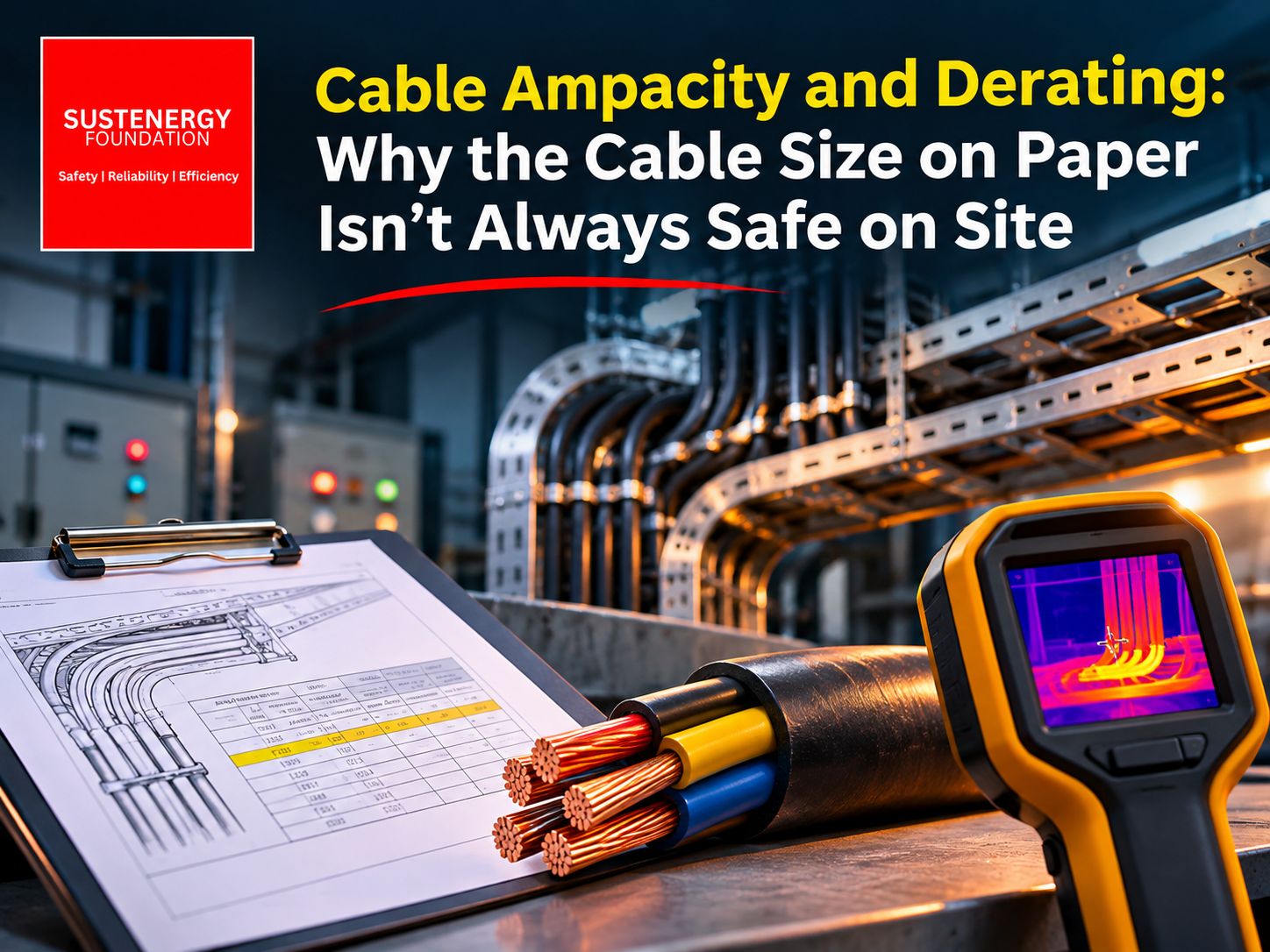
Cable Ampacity and Derating: Why the Cable Size on Paper Isn’t Always Safe on Site
Walk into any hospital, hotel or factory and you’ll find cables running everywhere: through shafts, across rooftops, packed into trays above ceilings. Most people never think about them. Electrical engineers do, because a cable that is sized wrong rarely fails loudly at first. It heats up quietly, ages faster, and one day it fails when you can least afford it.
Picking a cable is not just matching conductor size to the connected load. The real question is: can this cable carry that current safely in the place where it is actually installed? That is where cable ampacity and derating come in.
What Is Cable Ampacity?
Cable ampacity, also called current-carrying capacity, is the maximum continuous current a cable can carry without its conductor going past its permissible temperature, under stated installation conditions.
Several things decide that number:
- Conductor material (copper or aluminium)
- Conductor cross-sectional area
- Insulation type (PVC, XLPE) and its maximum operating temperature
- Ambient temperature
- Installation method
- How many loaded cables run together
- How well heat can escape
Here is the catch. The rating in a catalogue assumes reference conditions. Put the same cable in a hot electrical shaft, a closed conduit or a crowded cable tray, and it cannot safely carry the same current.
1. Ambient Temperature: Hot Surroundings Mean Less Capacity
Current flowing through a conductor creates heat because of resistance. That heat has to go somewhere, and it escapes into the air around the cable.
When surroundings get hotter, the gap between conductor temperature and air temperature shrinks. Less heat leaves the cable, so the cable must carry less current to stay within limits.
Think of two identical cables. One sits in an air-conditioned electrical room. The other runs along an open rooftop tray in peak summer, or through a poorly ventilated riser. Same cable, very different thermal life.
This matters a lot in India. Rooftop routes, industrial sheds, outdoor trenches and shafts often run far hotter than the design assumption. Designers should use real site temperatures, not comfortable ones.
2. Cable Grouping: Cables Warm Each Other Up
A single cable in free air sheds heat easily. Bundle many together and each one heats its neighbours.
Install ten loaded power cables tightly in one tray, and every cable loses some capacity. Each cable may look perfectly sized on its own, yet the group can run dangerously hot.
When checking grouping, look at:
- Number of cables installed together
- Number of loaded conductors
- Spacing between cables
- Single-layer or multilayer arrangement
- Tray type and ventilation
A simple fix often works: leave gaps, avoid stacking in layers, and stop cramming “one more cable” into a full tray.
3. Installation Method: Where the Cable Sits Matters
Heat escapes differently depending on how the cable is installed. Common methods:
- Open air
- Perforated or ladder trays
- Conduits
- Underground ducts
- Direct burial
- Enclosed electrical shafts
A cable in free air cools better than one inside a conduit or closed duct. Underground cables add more factors: soil thermal resistivity, burial depth, soil temperature and spacing between circuits.
So always size to the actual installation method. Catalogue ratings alone are not enough.
4. What Is Derating, and How Do You Calculate It?
Derating means reducing a cable’s reference current rating to match real conditions. A simple relationship used in design:
Iz = It × K₁ × K₂ × K₃
Where:
- Iz = corrected current-carrying capacity
- It = reference current-carrying capacity
- K₁ = ambient temperature correction factor
- K₂ = grouping correction factor
- K₃ = other factors, such as installation-specific conditions
A quick illustration (numbers are for explanation only): if a cable’s reference rating is 100 A, with K₁ of 0.87 for a hot ambient and K₂ of 0.75 for grouping, then Iz = 100 × 0.87 × 0.75 ≈ 65 A. That is a 35% drop from the catalogue figure. Choose the cable on the 100 A rating and you are already overloading it.
Pull the actual correction factors from the relevant standard tables for your cable type and installation. The corrected capacity must cover the design load and also satisfy overload and short-circuit protection requirements.
5. Why Derating Matters for Electrical Safety
Skip derating and you risk:
- Overheated cables and faster insulation ageing
- Early insulation failure
- More short circuits and earth faults
- Higher energy losses, since resistance rises with temperature
- Greater fire risk in cable shafts, electrical rooms and congested routes
- Lower reliability of critical systems
The stakes are highest in hospitals, hotels, data centres and industrial plants, where a power interruption is not just an inconvenience.
Final Thought: Correct Cable Selection Is a Safety Investment
Cable ampacity and derating are not minor calculations to rush through. Ambient temperature, grouping, installation method and heat dissipation together decide whether a cable lasts decades or becomes a hidden hazard.
Designers should follow applicable standards, including IS 732 and IEC 60364-5-52, and check cable manufacturer data when determining current-carrying capacity.
How Sustenergy Foundation Can Help
Already have cables running and not sure they are safe? Our electrical safety audits and energy audits find undersized cables, overloaded circuits and congested installations before they cause trouble. We also use thermal imaging inspection to spot overheating cables and loose terminations that the eye cannot see, and offer pre-commissioning electrical inspection for new installations and training for your maintenance team.
Serving industries and facilities across India, Maldives, Sri Lanka and Nepal. Contact Sustenergy Foundation to book an audit.