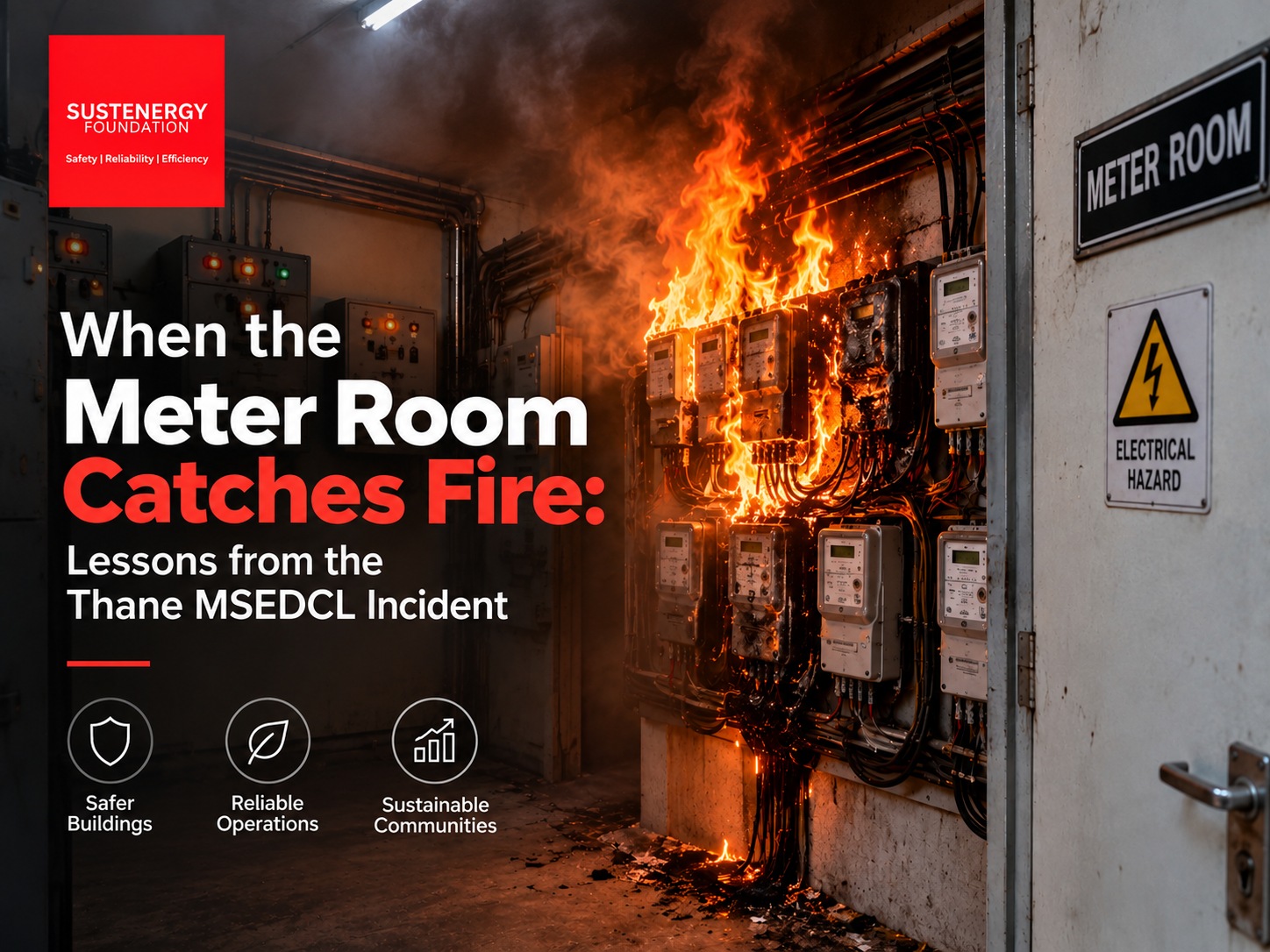
When the Meter Room Catches Fire: Lessons from the Thane MSEDCL Incident
A fire in an electrical meter room may initially seem like a small incident involving a few meters, cables and electrical connections. But in a multi-storey residential building, the meter room is directly connected to the electrical lifeline of dozens—or even hundreds—of residents.
When a fire starts in this space, the consequences can spread quickly. Smoke can enter common areas, electricity can be disrupted, electrical infrastructure can be damaged and, if the situation is not controlled in time, the incident can become a serious threat to life and property.
A recent incident at a housing society in Naupada, Thane, is a timely reminder of why electrical safety in residential buildings cannot be taken lightly.
On 21 August 2026, a fire broke out in the ground-floor MSEDCL meter-box room of a seven-storey building. Dense smoke resulted in the evacuation of around 100 residents, while another 35–40 occupants moved to the terrace as a precaution. Five meter boxes and the surrounding wiring were reportedly gutted. Fortunately, there were no casualties.
This was not the first such incident in Thane. Just two days earlier, a meter-box-room fire at another society in Kopri reportedly destroyed 16 electricity meters and required residents to evacuate.
These incidents raise an important question:
Are we doing enough to prevent electrical fires before they happen?
The Meter Room Is More Than Just a Place for Meters
An electrical meter room contains connections that carry substantial electrical current. Over time, several factors can increase the risk of overheating, arcing and electrical fires.
These may include:
- Loose or poorly tightened electrical connections
- Overloaded circuits
- Deteriorated cable insulation
- Poor-quality electrical accessories
- Inadequate electrical clearances
- Moisture and water ingress
- Dust accumulation
- Improper electrical modifications
- Poor housekeeping and ventilation
- Defective or incorrectly rated protective devices
According to safety guidance provided by MSEDCL, consumers should maintain proper earthing, use appropriately rated cables and protective devices, avoid loose connections and overloading, and ensure electrical faults are rectified through licensed electrical contractors.
The message is simple: electrical safety begins long before a fire starts.
Preventive Electrical Maintenance Is the First Line of Defence
One of the most effective ways to reduce the risk of electrical accidents is to have a structured preventive electrical maintenance programme.
Electrical installations should not be inspected only when something stops working. Regular inspection helps identify deterioration, overheating and unsafe conditions while there is still time to correct them.
For residential societies, commercial buildings and institutions, meter rooms and electrical panels should be periodically checked for:
- Loose, overheated or damaged terminations
- Discolouration and signs of electrical arcing
- Damaged cables and insulation
- Overloading and phase imbalance
- Condition of MCBs, MCCBs and other protective devices
- Earthing continuity and earth resistance
- Water ingress and excessive humidity
- Dust accumulation and housekeeping
- Adequate ventilation and accessibility
- Unauthorised wiring or electrical modifications
Thermal Imaging: Finding Problems Before They Become Fires
Traditional visual inspection may not always reveal an electrical problem.
Thermal imaging of electrical connections under load can help identify abnormal temperature rises and hidden hot spots that may otherwise go unnoticed.
An unusually hot connection can be an early indication of a loose termination, excessive loading, poor contact or another developing electrical fault.
Identifying such conditions early gives building management an opportunity to investigate and rectify the problem before it develops into equipment failure—or potentially an electrical fire.
This is an important part of a modern electrical safety and preventive maintenance strategy.
Annual Electrical Safety Audit: A Necessity, Not a Formality
For every residential society, commercial building and institutional facility, a comprehensive electrical safety audit should be treated as an essential part of responsible facility management.
Ideally, electrical installations should undergo a detailed safety assessment at least once every year through competent electrical safety experts or qualified authorities, with identified corrective actions properly documented and tracked until closure.
An effective electrical safety audit should not focus only on the meter room.
The assessment should cover the complete electrical installation, including:
- Incoming electrical supply
- Electricity meters
- Main electrical panels
- Distribution boards
- Cables and wiring
- Earthing systems
- MCBs, MCCBs and protective devices
- Electrical ducts and shafts
- Emergency electrical systems
- DG and other backup systems
- Electrical fire hazards
- Housekeeping and accessibility
- Unauthorised electrical alterations
The Maharashtra Fire Services' fire-hazard evaluation framework also identifies areas such as the location of substations, DG and meter rooms, electrical ducts, cables and housekeeping as important areas requiring attention.
This highlights an important point: electrical safety and fire safety are closely connected.
The Human Element Matters Too
Electrical safety is not only about equipment.
Building residents, maintenance teams, electricians, facility managers and housing-society committees all have a role to play.
A meter room should never become a storage area. Access should remain clear, electrical equipment should not be obstructed, and unauthorised modifications should be avoided.
Maintenance personnel should also know how to identify early warning signs such as:
- Burning smells
- Unusual buzzing or crackling sounds
- Repeated tripping of protective devices
- Flickering lights
- Hot electrical panels
- Visible cable damage
- Discolouration around electrical connections
These may appear to be minor problems, but they can sometimes indicate a developing electrical fault.
Reporting and correcting such problems early is one of the simplest ways to improve building electrical safety.
The Lesson from Thane
The meter-room fires reported in Thane should not be dismissed as simply "electrical faults."
They are reminders that electrical safety is a continuous process.
Good electrical design reduces risk.
Good operation helps detect abnormalities.
Preventive maintenance helps prevent failures.
Thermal inspection can identify hidden hot spots.
Regular electrical safety audits can reveal systemic weaknesses.
Fire-safety preparedness helps protect occupants when something does go wrong.
And most importantly, corrective actions must not stop with the audit report. Identified electrical safety issues should be followed through to closure.
Electrical Safety Supports Sustainable Buildings
Sustainability is often discussed in terms of energy efficiency, renewable energy and reducing environmental impact. But a truly sustainable building must also be safe, reliable and well maintained.
An electrical system that operates efficiently but has unsafe connections, overloaded circuits or neglected maintenance is not a resilient electrical system.
Good electrical energy management therefore goes hand in hand with electrical safety.
Preventing electrical failures can reduce equipment damage, avoid unnecessary downtime, improve the reliability of electrical infrastructure and help extend the useful life of electrical assets.
For organisations working toward safer and more sustainable buildings, electrical safety audits, preventive maintenance, energy management and responsible operation should be viewed as interconnected practices rather than separate activities.
Prevention Costs Less Than a Fire
The cost of an annual electrical safety audit is small when compared with the potential consequences of an electrical fire.
A serious incident can result in:
- Property damage
- Damage to electrical infrastructure
- Prolonged power interruptions
- Disruption to residents and businesses
- Expensive equipment replacement
- Emergency response costs
- Risk to occupants and maintenance personnel
- Potential loss of life
The real value of an electrical safety audit is therefore not the report itself.
Its value lies in finding problems early and ensuring that they are corrected.
A Safer Electrical Future Starts with Prevention
The safest electrical system is not necessarily the one that never develops a fault.
It is the one in which faults are identified early, risks are assessed properly and corrective action is taken before those faults become fires.
The incidents reported in Thane provide a practical reminder for housing societies, facility managers, commercial establishments and institutions across India.
Don't wait for smoke from the meter room to tell you there is a problem.
Inspect. Identify. Correct. Maintain. Audit. Prevent.
Electrical safety is not a one-time activity. It is an ongoing responsibility—and an essential part of building a safer, more reliable and sustainable future.